

Hey there! As a supplier of tubular heat exchangers, I've seen firsthand how crucial it is to understand the relationship between fluid velocity, heat transfer, and pressure drop. It's like a three - way dance, and getting it right can make a huge difference in the efficiency and performance of these heat exchangers.
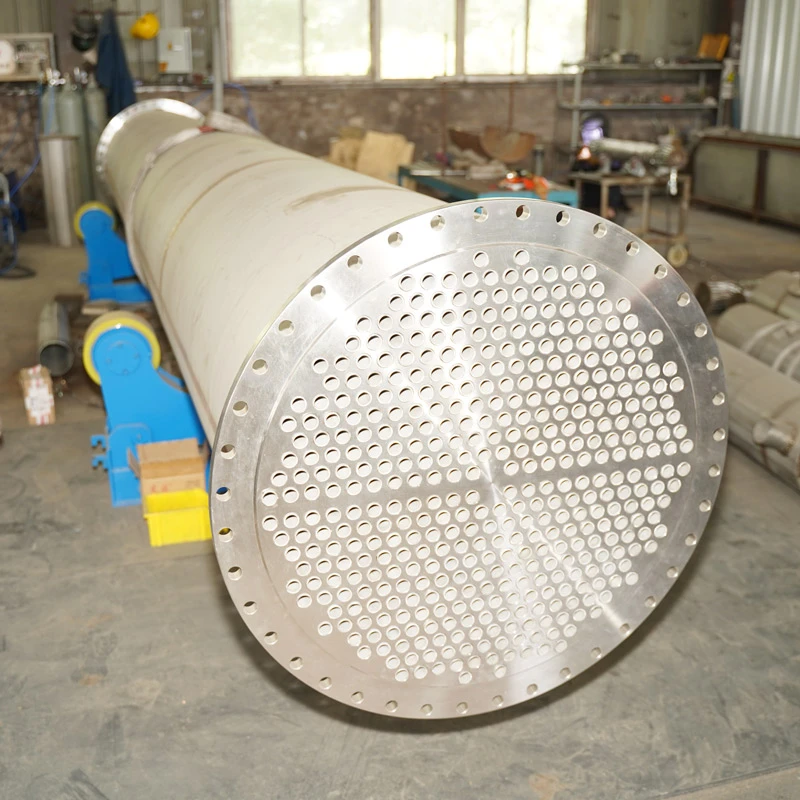
Let's start by talking about what heat exchangers are. Tubular heat exchangers are devices that transfer heat between two fluids. One fluid flows through the tubes, and the other flows around them. They're used in a bunch of industries, from chemical processing to power generation, and even in our everyday appliances like refrigerators.
Now, when it comes to fluid velocity, it plays a starring role in both heat transfer and pressure drop. First up, heat transfer. Heat transfer in a tubular heat exchanger happens mainly through conduction and convection. Conduction is when heat moves through the tube wall, and convection is when the fluid takes the heat with it as it moves.
As the fluid velocity increases, the heat transfer coefficient also goes up. Why? Well, at higher velocities, the fluid mixes more vigorously. Think of it like stirring a hot drink. When you stir it, the heat spreads out faster. In a heat exchanger, the increased mixing means that fresh, "cold" fluid is constantly brought into contact with the tube wall. This fresh fluid can absorb more heat from the tube wall, enhancing the overall heat transfer rate.
A study by some researchers found that if you double the fluid velocity in a typical tubular heat exchanger, the heat transfer coefficient can increase by about 50 - 100%. Just imagine what that means for your heat transfer process! More heat is transferred in less time, which can lead to greater efficiency and potentially save you a lot of energy costs.
But, and there's always a but, increasing the fluid velocity isn't all sunshine and rainbows. Enter the pressure drop. Pressure drop is the loss of pressure that occurs as the fluid flows through the heat exchanger. It's like the resistance you feel when you try to push water through a narrow pipe.
As the fluid velocity goes up, the pressure drop increases too. And it's not a linear relationship; it's an exponential one. In simple terms, a small increase in velocity can cause a big jump in pressure drop. This is because at higher velocities, there's more friction between the fluid and the tube wall, and also more turbulence in the fluid flow.
High pressure drops can be a real headache. They require more energy to pump the fluid through the heat exchanger. This means higher operating costs. In some extreme cases, if the pressure drop is too high, it can even lead to problems like pump cavitation, which can damage your equipment.
Now, let's talk about how all this affects the types of tubular heat exchangers we offer. We have some great options like the Compact Tubular Heat Exchanger. These are designed to be space - saving, and the fluid velocity can have a unique impact on their performance. Because they're more compact, the flow paths are shorter, which can lead to different heat transfer and pressure drop characteristics compared to larger heat exchangers.
The Mild Steel Tubular Heat Exchanger is another popular choice. Mild steel has different thermal conductivity properties compared to other materials. So, when you change the fluid velocity, the heat transfer and pressure drop behavior will be influenced by the material's ability to conduct heat.
And then there's the Stainless Steel Heat Exchanger. Stainless steel is known for its corrosion resistance, but it also affects how heat is transferred and how pressure drop occurs. The smooth surface of stainless - steel tubes can reduce friction, which might lead to a lower pressure drop compared to other materials at the same fluid velocity.
So, how do you find that sweet spot between maximizing heat transfer and minimizing pressure drop? It's all about a careful balance. You need to consider factors like the type of fluid you're using (its viscosity, density, and thermal conductivity), the size and material of the heat exchanger tubes, and the overall operating conditions.

For example, if you're dealing with a very viscous fluid, you might not be able to increase the velocity too much without causing a huge pressure drop. On the other hand, if you're using a low - viscosity fluid, you might be able to get away with a higher velocity to boost the heat transfer.
As a supplier, we're here to help you make these decisions. We have a team of experts who can analyze your specific requirements and recommend the best tubular heat exchanger and operating conditions for your application. Whether you're looking to upgrade an existing system or install a new one, we've got you covered.
If you're in the market for a tubular heat exchanger or just want to learn more about how to optimize your current setup, don't hesitate to reach out. We're always happy to have a chat and see how we can help you get the most out of your heat transfer process.
In conclusion, fluid velocity has a profound impact on both heat transfer and pressure drop in tubular heat exchangers. By understanding this relationship and working with the right supplier, you can ensure that your heat exchanger operates efficiently, saving you money and keeping your processes running smoothly.
References
- Incropera, F. P., & DeWitt, D. P. (2002). Fundamentals of Heat and Mass Transfer. John Wiley & Sons.
- Kakaç, S., & Liu, H. (2002). Heat Exchangers: Selection, Rating, and Thermal Design. CRC Press.