

Hey there! As a supplier of tubular heat exchangers, I've been in the thick of understanding all the ins and outs of these amazing pieces of equipment. One question that often pops up is, "What is the role of fins in a tubular heat exchanger?" Well, let's dive right in and break it down.
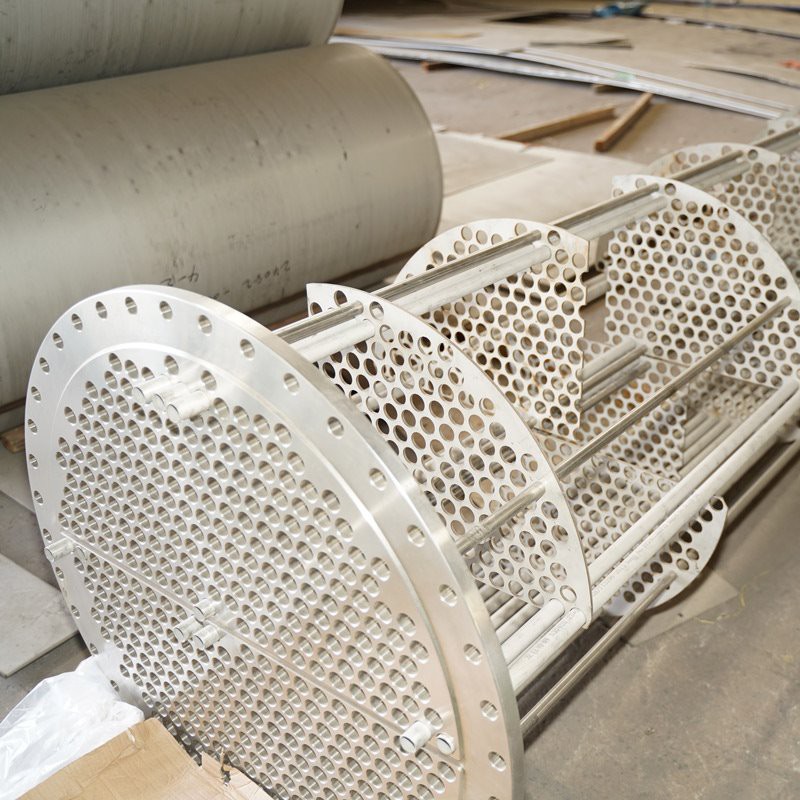
First off, let's get a quick overview of tubular heat exchangers. They're used in a whole bunch of industries, from chemical processing to food and beverage, and even in pharmaceuticals. There are different types, like the Industrial Tubular Heat Exchanger, which is designed for heavy - duty industrial applications, the Compact Tubular Heat Exchanger that's great when space is tight, and the Pharmaceutical Tubular Heat Exchanger that meets the strict hygiene standards of the pharma industry.
Now, let's talk about fins. Fins are basically extended surfaces attached to the tubes in a tubular heat exchanger. Their main job is to enhance heat transfer. You see, heat transfer in a heat exchanger happens through conduction, convection, and sometimes radiation. But in most tubular heat exchangers, conduction and convection are the key players.
When a fluid flows over a tube in a heat exchanger, heat is transferred from the fluid to the tube wall (or vice - versa). The rate of this heat transfer depends on a few things, like the temperature difference between the two fluids, the properties of the fluids (such as their thermal conductivity, density, and viscosity), and the surface area available for heat transfer. This is where fins come in super handy.
By adding fins to the tubes, we significantly increase the surface area available for heat transfer. Think of it like this: if you have a plain tube, the heat can only be transferred through the outer surface of that tube. But when you add fins, it's like adding a bunch of little extra surfaces that the fluid can interact with. So, more of the fluid comes into contact with a larger surface area, and heat can be transferred more efficiently.
Let's take an example of an industrial process where a hot fluid needs to be cooled down. Without fins, the heat transfer might be slow, and you'd need a larger heat exchanger to achieve the desired cooling. But when you add fins, the same amount of heat can be transferred in a much smaller heat exchanger. This means you can save on space, materials, and cost.
Another important aspect is the type of fins. There are different types, such as straight fins, spiral fins, and pin fins. Straight fins are the simplest and are often used in applications where the fluid flow is relatively uniform. They're easy to manufacture and can provide a good increase in surface area. Spiral fins, on the other hand, are wrapped around the tube in a spiral pattern. This type of fin can enhance the fluid mixing as the fluid flows over the fin, which further improves heat transfer. Pin fins are small, cylindrical fins that are attached to the tube surface. They're great for applications where the fluid has a low flow rate, as they can still provide a large surface area for heat transfer.
The material of the fins also matters. Fins are usually made from materials with high thermal conductivity, like aluminum or copper. These materials can quickly conduct heat from the fluid to the tube or vice - versa. Aluminum is lightweight and relatively inexpensive, making it a popular choice for many applications. Copper, on the other hand, has even better thermal conductivity but is more expensive. So, the choice of material depends on the specific requirements of the heat exchanger, such as cost, weight, and the operating environment.
Now, let's talk about how fins affect the pressure drop in the heat exchanger. When a fluid flows over fins, it has to navigate around these extra surfaces. This can cause an increase in the pressure drop across the heat exchanger. A higher pressure drop means that more energy is needed to pump the fluid through the heat exchanger. So, it's a bit of a balancing act. You want to increase the surface area for heat transfer with fins, but you don't want the pressure drop to get too high.
Manufacturers have to carefully design the fins to optimize this balance. They can adjust the fin height, thickness, spacing, and shape to find the sweet spot where heat transfer is maximized, and the pressure drop is kept within an acceptable range.

In some applications, fins can also help with fouling. Fouling is the accumulation of unwanted materials on the tube surfaces, which can reduce the heat transfer efficiency. Fins can sometimes disrupt the flow pattern of the fluid in such a way that it helps prevent the buildup of fouling materials. For example, the swirling flow created by spiral fins can make it harder for particles to stick to the tube surface.
In summary, fins play a crucial role in tubular heat exchangers. They enhance heat transfer by increasing the surface area available for heat exchange, which allows for more efficient operation of the heat exchanger. They can also help with space savings, cost reduction, and in some cases, fouling prevention. However, the design of the fins needs to be carefully considered to balance the benefits of improved heat transfer with the potential increase in pressure drop.
If you're in the market for a tubular heat exchanger and want to learn more about how fins can benefit your specific application, don't hesitate to reach out. We're here to help you find the perfect heat exchanger solution that meets your needs. Whether you need an industrial - grade heat exchanger for a large - scale manufacturing process, a compact one for a space - constrained facility, or a pharmaceutical - compliant heat exchanger, we've got you covered.
References
- Incropera, F. P., DeWitt, D. P., Bergman, T. L., & Lavine, A. S. (2017). Fundamentals of Heat and Mass Transfer. John Wiley & Sons.
- Kakac, S., & Liu, H. (2002). Heat Exchangers: Selection, Rating, and Thermal Design. CRC Press.